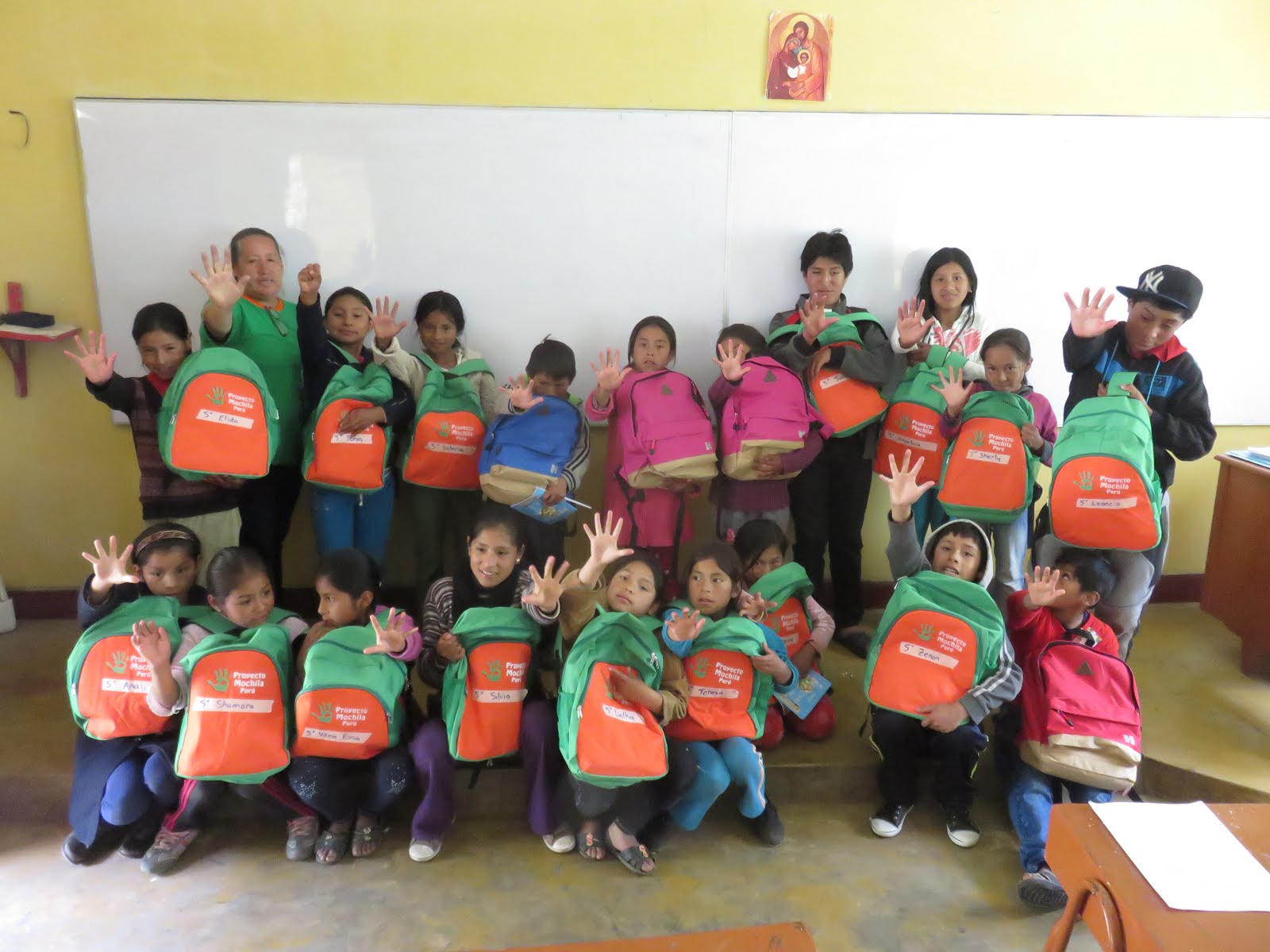
 Project Mochila is a summer school programme for primary ages, focused on literacy and numeracy for children in areas where education may be poor. At the end of the week the children who've participated receive a rucksack (mochila) with school materials.
We (AIDIA, accompanied by several volunteers, and a team of puppeteers from Lima) ran the project in one of AIDIA's focus districts near Abancay.
As well as teaching maths and communication we also gave health-related workshops which I coordinated - topics of water, hygiene, dental care, the environment and nutrition.
 Day 0 - preparations
We loaded up all our luggage for the week, lots of food to contribute, sleeping bags, teaching materials, rucksacks for the children, and lots of puppets. There was barely room for 3 of us to travel as well, but we squeezed in (including my guitar - thanks to frequent childhood practice).
Arriving 2 hours later we unpacked and carried everything into one of the classrooms at the school, and then proceeded to blow up about 100 balloons and tie them onto sticks ready to make an arch in the morning to welcome the students.
We hadn't sorted out accommodation yet, so stayed with one of the couples from the church - 3 of us sharing a mattress on the floor of their room. It was very cold but we slept well under 5 blankets.

About 100 children came, along with the school director, ministry of health representatives, and people from the mayor's office. There were speeches, we sang the national anthem and raised the flag, and then everyone was off to their classes.

My first class was with the parents, teaching about hygiene. I really
appreciated how the teaching is focused on visuals and group
contribution, because I was conscious that some of the parents didn't
speak Spanish. I could help a little in Quechua but it was great to
have them working together and explaining to one another.
 After the break I taught 3rd and 4th grade about water. It was a
disaster! Well, I thought so at the time. I used a story to tell them
about the water cycle, and actually they listened quite well to that
part. But they were far too hyperactive for the activity I had planned
for them afterwards, wanting to play, run around, shout, look out of the window, fight, or ask me
questions about where I am from. I have an increased respect and
appreciation of teachers. Always before when I've worked in schools,
I've been visiting but the teacher has always been present - this time I
was in sole "control"!
After the break I taught 3rd and 4th grade about water. It was a
disaster! Well, I thought so at the time. I used a story to tell them
about the water cycle, and actually they listened quite well to that
part. But they were far too hyperactive for the activity I had planned
for them afterwards, wanting to play, run around, shout, look out of the window, fight, or ask me
questions about where I am from. I have an increased respect and
appreciation of teachers. Always before when I've worked in schools,
I've been visiting but the teacher has always been present - this time I
was in sole "control"!
We spent the afternoon preparing our next classes but also borrowing
various mattresses and blankets from the mayor's office and setting up
our sleeping arrangements (a room for the boys and one for the girls,
with 8 mattresses and 18 blankets to share between 13 of us - and a cold
shower!).
 Day 2
Day 2
Today I was teaching 5th and 6th grade about the environment after the break, but had nothing scheduled first thing. So I asked if I could help with the morning literacy classes - so that I would know the students and they would know me by the time it came to my classes. This worked far better than yesterday! I also enjoyed being able to help the children while they thought up adjectives to describe the different animals in their district (a slippery fish, or a thieving weasel).
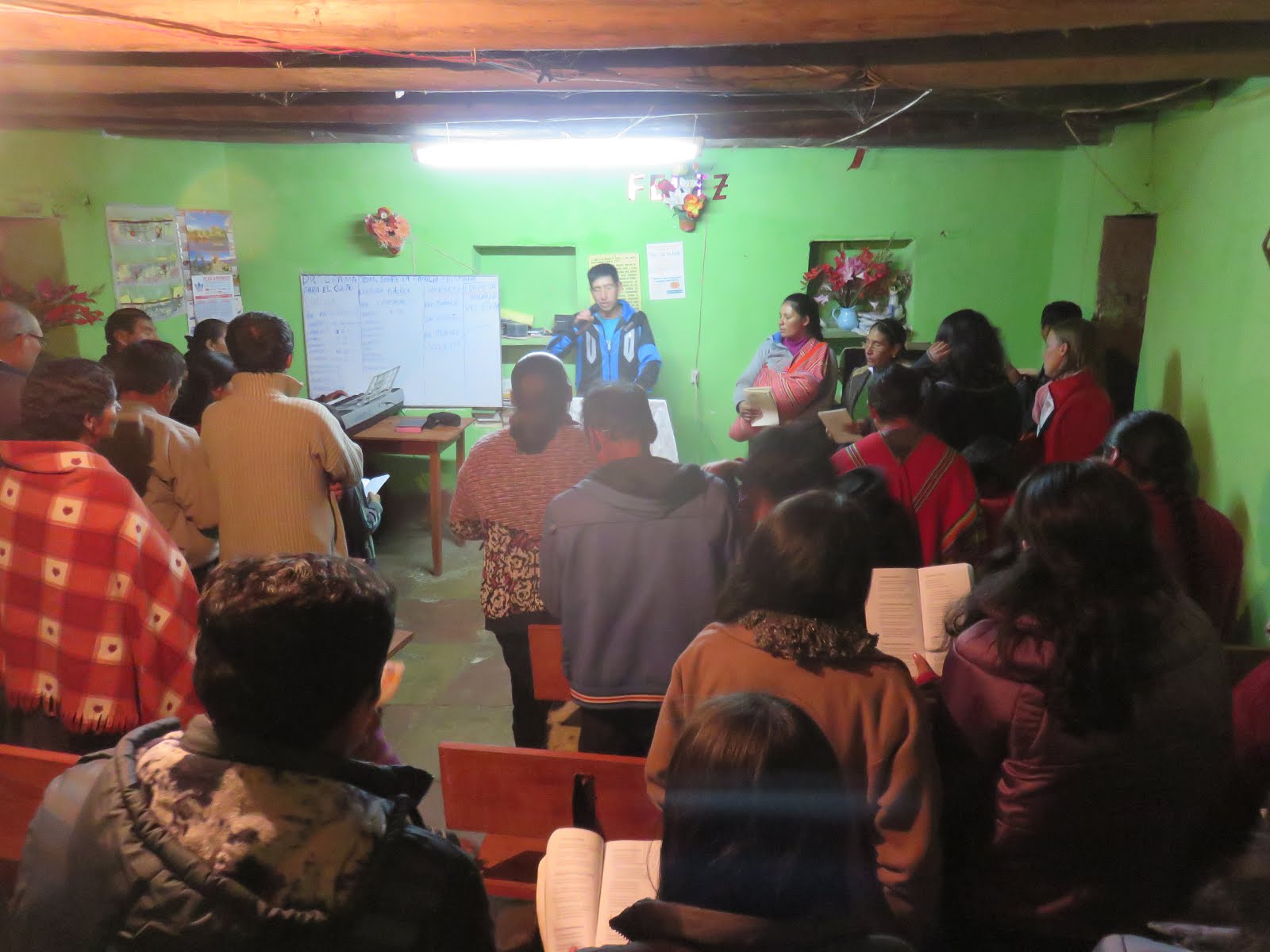 In my class we talked about how God created everything, and how we as humans are both dependent on and responsible for the natural world. Then we looked at different types of waste and how long things take to decompose - there were quite a few surprises, mainly that "disposable" polystyrene cups and trays take perhaps forever to decompose.
In the evening there was a church service - usually a prayer meeting on Tuesdays but tonight was full of "specials" - songs prepared bu different groups, including us. I led "Alelu alelu alelu aleluia" complete with standing up and sitting down - I even know it in Quechua because there are only 3 other words!
A musical interlude...
 |
| Food in the school canteen |
It was my turn to lead our morning's devotions today, so I talked a little about Samuel growing up in God's house surrounded by his influence - and how our hope is that we can contribute to building this positive environment for the children here. We spent the rest of the time praying for the week.
At breakfast I had a lovely surprise. One of the boys from Monday's horrendous class came and recounted to me the story I'd told them about the water cycle - and there was I thinking I hadn't been able to teach them anything at all!
 |
| Board game to learn the vowels |
Then I was with 5th and 6th again, teaching them about hygiene. This is one of my favourite lessons as it's very picture based and very interactive. I basically don't teach much but get the class to tell me everything. But it's very hard to get people to admit that they don't already do all of the "good behaviours".
In the afternoon I came back to Abancay to pick up some more materials from the office and go to my Quechua classes (they are every night but I'd said I would go to one this week).


Day 4
I got an early car back and this morning I had another teaching session with the parents. I wasn't actually teaching but generally facilitating and I wanted to observe the nutrition teaching because it was based on the materials I'd prepared.
 Gianella who is a student from Arequipa taught about
nutrition. She included some extra elements in her teaching was were
very helpful and I'll be noting for the future. It was great to see the
mothers using the cards we'd prepared to plan meals containing the 3
food groups, and to hear a lady from the church explaining our
illustrative 3-legged stool in Quechua - both showing that she'd
understood, but also effectively translating for those who hadn't.
Gianella who is a student from Arequipa taught about
nutrition. She included some extra elements in her teaching was were
very helpful and I'll be noting for the future. It was great to see the
mothers using the cards we'd prepared to plan meals containing the 3
food groups, and to hear a lady from the church explaining our
illustrative 3-legged stool in Quechua - both showing that she'd
understood, but also effectively translating for those who hadn't.Luis taught about dental care - focusing not on what you can and can't eat but on how important it is to clean your teeth. Since seeing his graphic illustrations I have been cleaning my teeth even after lunch!

Then I had my lesson with grades 1 and 2. Again it was
really helpful to have met them yesterday and got an idea of their
learning level. My story was very successful and they enjoyed retelling
it to me. (It works with every age group! It's based on a book I had
when I was small. A child wants to say thank you for his drink, so
thanks first the glass, then the tap, and the pipes... and so on as each
one tells him where the water came from. It finishes with him
discovering that God made, or helped us make, all these things and so he
prays his thanks to God.) Then we went outside for some water-carrying
games.


Day 5
They needed help in the kitchen today (we've been preparing mid-morning snacks for the children) so I learned how to make humitas (although there is some debate as to when it's an humita and when it's a tamal - it depends on the freshness of the corn but also on whether it's sweet or savoury).


Then my final class, teaching grades 5 and 6 about water. Because of the other classes happening today, this time the two were combined which meant about 60 children! It was chaos, but they still listened attentively to the story. Afterwards, I got them together in groups depending on which village they came from, to draw a map of their community including the elements of their water cycle.


We also had a class teaching grades 3/4 about hand-washing. This was also a combined class and as I'd had such trouble with them I figured I ought to help Luis. We used an idea I've been wanting to try out for ages - mixed glitter with vaseline and he went round shaking everyone's hand to get them good and coated. Then we demonstrated how you have to wash your hands properly in order to get the glitter off. It's great to know how well this works - I shall be using it again!


Day 6
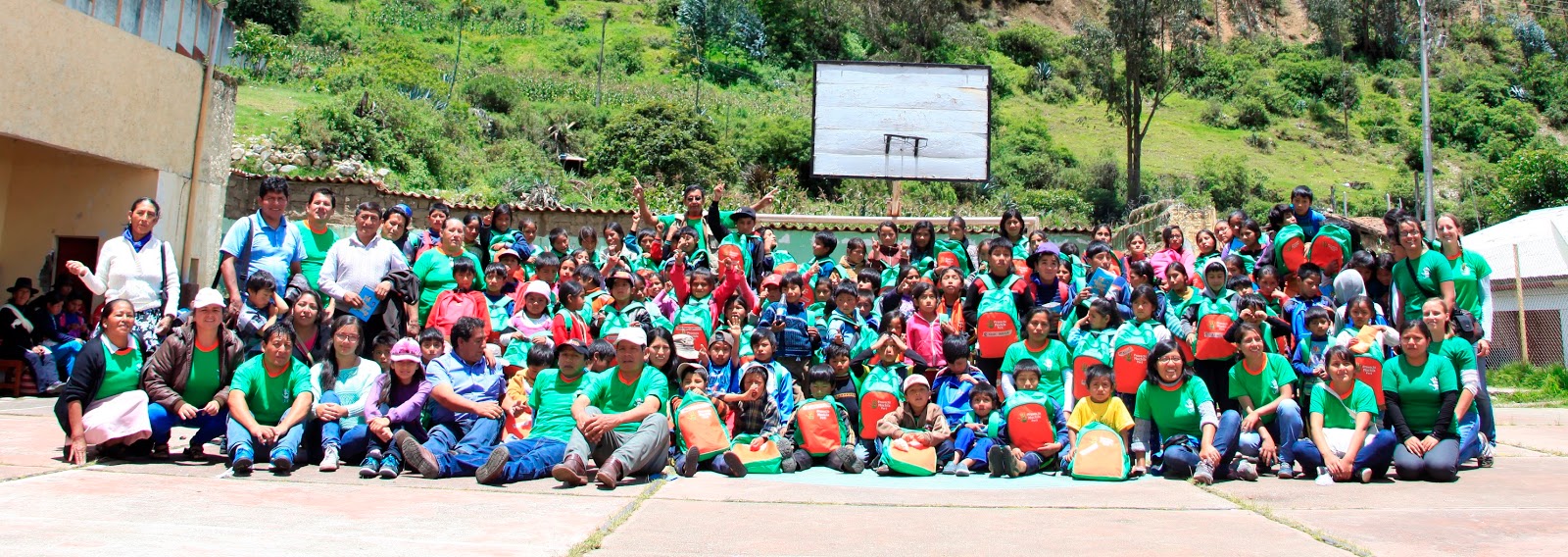
The closing ceremony! There were lots of contributions from the puppets and lots of speeches. Even I made a speech, first learning to correctly greet all the various personages (this time the mayor came) and then congratulating the children as I can't imagine British children voluntarily coming to lessons in their holidays!


The
mothers had prepared a special surprise for us - which of course turned
out to be lunch: fried trout with potatoes and a chili sauce. It was
delicious.


When we'd
packed everything up we hired a couple of minibuses to take us up the
mountain to the lakes at the top. We posed for lots of photos and
tried to throw each other in (sort of). It was beautiful and very cold
because it's so high. Coming back down then it was a long and squashed
journey back to Abancay with all the luggage.


